You Have Years of Experience. Now You Need Clarity About What It Can Become Next.

You have worked for years.
You have sat in important meetings, managed difficult assignments, guided teams, solved problems and carried responsibilities that many people never saw.
People trusted your judgement. Your name meant something in your field. Your work gave structure to your days and a clear answer when someone asked, “What do you do?”
Then the role ended.
Perhaps the contract was not renewed. Perhaps restructuring removed your position. Perhaps you retired earlier than expected. Perhaps you chose to leave because the work no longer fitted the life you wanted.
At first, you thought the next opportunity would come quickly. After all, you had experience, a strong CV and a respectable network.
But weeks became months. Applications disappeared into silence. Former colleagues responded warmly, but nothing concrete followed.
You began looking in several directions at once. Consultancy. Training. A small business. Board service. Farming. Another senior role. Maybe coaching. Maybe a completely new industry.
Every idea sounded possible for a few days. Then the questions returned.
What exactly can I offer now? Who would pay for it? Am I too late? Has the market moved on without me?
From the outside, you still look accomplished. People assume you are taking a well-earned break or choosing carefully between opportunities.
Privately, the reduced income is beginning to concern you. You do not want to panic. You do not want to accept just anything. But you also cannot remain in endless reflection while your confidence slowly declines.
The deepest frustration is this: you know you have value, but you cannot yet explain that value in a way the current market understands.
You do not want to start from zero. You do not want to erase twenty or thirty years of learning and pretend you are a beginner.
You need a clear way to examine what you have built, identify what still matters, connect it to a real need and choose a practical income direction.
Drop everything you are doing now and listen to every word I’m about to say.
This is not a magic formula. It is not a promise that one worksheet will produce a job, a contract or instant income.
It is a practical way of doing something experienced professionals are rarely taught to do: separating their value from the title they once held.
For decades, professionals were encouraged to build careers, remain loyal, gain qualifications and move upward. Very few were taught how to translate all that experience when the formal role finally ended.
The story that follows is an illustrative professional scenario created from experiences commonly faced by seasoned professionals navigating major work and income transitions. Wanjiku Mwangi is a fictional composite character, not a customer or identifiable individual.
Hi, my name is Wanjiku Mwangi.
First thing you should know about me is that I’m not a career coach, recruitment expert or financial adviser. I’m simply a 52-year-old wife, mother and former development-sector leader who spent months trying to understand what came after a twenty-two-year career.
I had experience. I had credibility. I had contacts. Yet for a long time, I could not turn any of it into a clear next step.

The Day I Realised Experience Alone Was Not Enough
For more than twenty-two years, my professional life had followed a clear path.
I worked in programme management, partnerships and organisational leadership within the development sector. I managed teams, coordinated complex programmes, supported senior decision-makers and represented my organisation in meetings where every word mattered.
I was used to full calendars, deadlines and people calling because they trusted me to solve something.
My work was demanding, but it also gave me identity. It gave me confidence. It gave me a familiar place in the world.
Then my role ended.
There was no dramatic public collapse. No scandal. No single moment that explained everything.
One season simply closed, and I suddenly found myself outside the structure that had shaped most of my adult life.
At first, I was calm.
“I have good experience,” I told my husband. “Something suitable will come.”
I updated my CV. I revised it again. Then I paid someone to make it look more modern.
I contacted former colleagues. Most were kind.
“Wanjiku, you have such a strong profile.”
“Any organisation would be fortunate to have you.”
“I will keep my ears open.”
The words encouraged me for a day or two. But weeks passed without anything concrete.
I applied for roles similar to the one I had left. Some were below my previous level. Others required experience I had, but the organisations wanted someone younger, cheaper or already known within their current networks.
I rarely received a direct rejection. Mostly, there was silence.
That silence began to work on me.
I started wondering whether twenty-two years of experience had somehow become too much and not enough at the same time.
Too much for some positions. Not current enough for others.
People around me still saw the confident professional they had always known. I did my best to remain that person.
But at home, I was becoming restless.
I would wake up early, open my laptop and move between job sites, LinkedIn, webinars and notes for business ideas.
One morning I was researching consultancy registration. By afternoon, I was watching a video about agribusiness. The following day, I was considering an online course in coaching.
I made a list titled “Possible Next Steps.”
It included consultancy, training, board work, farming, retail, another NGO role, project management, mentoring younger professionals and starting a small events business with a friend.
The list looked productive. In truth, it was evidence that I had no clear direction.
My husband noticed.
One evening he asked, “Which of these things do you actually want to pursue?”
I answered too quickly.
“I’m still exploring.”
He nodded, but the question stayed with me.
After several months, the emotional cost became harder to hide.
I felt embarrassed whenever someone asked what I was doing now. I would give long explanations about taking time to reflect, exploring consultancy and waiting for the right opportunity.
The more I explained, the less convincing I sounded to myself.
My confidence did not disappear all at once. It reduced quietly.
I began avoiding some professional gatherings because I did not want another conversation that started with, “So, where are you working these days?”
I also became sensitive to money in a way I had not been before.
Ordinary expenses felt heavier. Every purchase raised a question about how long our savings needed to stretch.
I was not without support. My husband was steady and kind. But I had always contributed significantly, and losing that regular income affected more than our budget.
It affected how I saw myself.
The breaking point came after a conversation with a former colleague.
She had called to check on me. We spoke warmly for a few minutes, then I told her I was open to consulting, training, programme work, advisory assignments and possibly another leadership role.
There was a pause.
Then she asked, “What kind of consulting do you want to do?”
I gave an answer filled with words but lacking a clear point.
I mentioned programme strategy, partnerships, organisational growth, leadership, stakeholder engagement and capacity building.
She listened, then said gently, “You have done many things, Wanjiku. I’m just not sure what I should refer you for.”
That sentence hurt because it was true.
My contacts knew what I had done in the past. They did not know what I wanted to do now.
After the call, I sat in my car and cried.
Not because she had been unkind. She had actually given me the most honest feedback I had received.
I had spent months telling people I was available without giving them a clear reason to remember, recommend or hire me.
That weekend, I spoke with my older cousin, Ruth.
Ruth had gone through her own professional transition several years earlier. She listened without interrupting as I described the applications, webinars, business ideas and growing fear that I was becoming invisible.
Then she said something I have never forgotten.
“Wanjiku, you are trying to replace your old job before you have understood what the old job built inside you.”
I went quiet.
She continued.
“Your title ended. Your value did not. But until you can name that value clearly, every option will look equally possible and equally confusing.”
That conversation gave me hope, but I still did not know what to do next.
So I continued searching.
I tried updating my CV again. It became more polished, but it still described where I had been rather than where I was going.
I applied for roles similar to my former position. The applications kept me busy, but they did not help me decide whether I genuinely wanted another full-time role or simply wanted the security of something familiar.
I called former colleagues and said, “Please let me know if you hear of anything.” They agreed, but the request was too broad to produce useful referrals.
I attended motivational webinars. I left feeling hopeful, but by the next morning I still had no decision framework, no positioning statement and no focused action plan.
I considered several unrelated income ideas at the same time. Each new possibility delayed the hard work of choosing one direction long enough to test it properly.
I even drafted a consultancy profile. It had a strong name, professional colours and a long list of services. But it did not clearly explain the problem I solved, the people I served or the outcome they could expect.
I had created the appearance of a business without defining a useful offer.
Then, one Tuesday evening, I came across an article shared in a professional WhatsApp group.
The title was about experienced professionals who feel stuck after leaving formal employment.
One sentence stopped me:
The article was written by Grace M., a career-transition facilitator in her mid-fifties with a background in organisational development, programme leadership and professional training.
She sounded different from the people offering quick reinvention formulas.
She did not tell experienced professionals to become influencers, start random online businesses or pretend the transition was easy.
She wrote about identity, transferable value, positioning and the need to connect accumulated experience to present market problems.
A week later, I attended one of her virtual sessions.
There were professionals from several sectors: banking, government, education, development work and healthcare.
Grace asked each person to introduce themselves without using a former job title.
The room became uncomfortable.
We knew how to say, “I was a regional director,” or “I worked as a programme manager.”
We did not know how to explain the value underneath those titles.
Then Grace said:
“Stop asking only, ‘What job can I get?’ Ask, ‘What difficult problems have I repeatedly solved, who still has those problems and which of them am I willing to solve now?’”
Someone asked whether that was enough.
Grace smiled.
“Do not rush to replace the role you have left. First understand what has changed. Separate who you are from the title you held. Recover the value built through your experience. Reassess where that experience may still be relevant. Compare the pathways available to you. Then choose a direction and begin testing it through purposeful conversations.”
She described it as a practical six-stage process for moving from transition and uncertainty toward greater clarity, realistic income direction and structured action.
I did not fully believe it at first because it sounded almost stupidly simple.
I had expected something more complicated. Perhaps a sophisticated assessment, a new qualification or a detailed business plan.
Instead, the first exercise asked me to list difficult problems I had repeatedly solved throughout my career.
For the first two days, I avoided it.
When I finally began, I wrote job duties instead of problems.
“Managed partnerships.”
“Coordinated programmes.”
“Supported leadership.”
The words looked familiar but lifeless.
I almost stopped.
Then I returned to Grace’s question: What was difficult before you became involved, and what became better because of your work?
That changed everything.
I remembered a partnership that was close to collapsing because communication had broken down between several organisations. I had rebuilt trust, clarified responsibilities and created a reporting structure that kept the programme moving.
I remembered senior leaders who had strong ideas but struggled to turn them into clear proposals, presentations and stakeholder messages. I had helped them organise complex thinking and communicate it with authority.
I remembered teams that were working hard but pulling in different directions. I had created systems, clarified priorities and helped them deliver together.
For the first time in months, I felt something inside me settle.
I was no longer looking at a dead job title. I was looking at a living body of value.
That was the breakthrough moment.
Nothing dramatic happened outside me. No job offer arrived that afternoon. No client called.
But internally, the fog began to lift.
I could see that my experience was not one large, vague thing called “twenty-two years in development.”
It was a collection of specific, useful abilities.
I could help organisations strengthen partnerships. I could help leaders communicate complex ideas. I could help teams turn programmes into structured action.
Over the next few days, I compared several income paths.
I considered returning to employment, but I realised I did not want to apply indiscriminately. I wanted roles where partnership strategy, programme leadership and executive communication were central.
I also considered consultancy. This time, I did not begin with a company name. I began with a problem I could solve.
I drafted a new professional introduction:
“I support growing organisations and development teams to strengthen partnerships, programme coordination and executive communication, drawing from more than twenty years of leadership and stakeholder-engagement experience.”
It was not perfect. But it was clear enough to test.
I sent it to three trusted former colleagues and asked what they understood from it.
One replied:
“I always knew you had strong experience, but this is the first time I have clearly understood the type of work you are now interested in doing.”
Another introduced me to the director of a small organisation that needed help preparing for a strategic partnership meeting.
That conversation did not immediately become a large contract. It became something equally important at that stage: real market feedback.
I could finally discuss a relevant problem instead of announcing that I was available for anything.
My husband noticed the change before I mentioned it.
One Saturday morning, I was explaining the two income directions I had selected: targeted leadership roles and focused project-based advisory work.
He looked at me and said:
“For the first time since you left your job, I can hear that you are not just searching for anything. You are clearer about what you know, who may need it and what you want to pursue.”
That sentence meant more to me than he realised.
He was not praising a final result. He was recognising direction.
And direction was what I had been missing.
During the virtual session, other participants began having similar moments.
A former banking leader realised that his value was not simply “thirty years in banking.” It was his ability to improve credit decision-making, mentor branch leaders and strengthen operational controls.
A retired educator recognised that she could offer school-leadership mentoring and curriculum implementation support instead of vaguely saying she wanted to “do consultancy.”
A former NGO finance manager saw that her strongest next path might combine short-term financial-systems assignments with board and governance work.
None of us received guaranteed outcomes.
What we received was a better way to think.
We stopped treating our experience as a closed chapter. We began examining it as evidence, capability and potential value.
We stopped chasing every possible direction. We started comparing options using practical criteria.
We stopped asking contacts to keep us in mind for “anything.” We started explaining the specific contribution we were ready to make.
That is what the clarity and income direction process did for me.
It did not remove every uncertainty. It did not promise effortless success.
It helped me move from scattered searching to structured action.
And after speaking with other experienced professionals, I realised how many people needed the same starting point.
So I Put the Process Into One Practical Four-Part Toolkit
I kept meeting experienced professionals who had spent fifteen, twenty or thirty years building knowledge, judgment and credibility, yet were struggling to work out what all that experience could become next.
Many had updated their CVs, attended webinars, explored business ideas or contacted former colleagues. What they often lacked was a structured way to understand what had changed, recover the value in their experience, compare realistic income directions and decide what to test next.
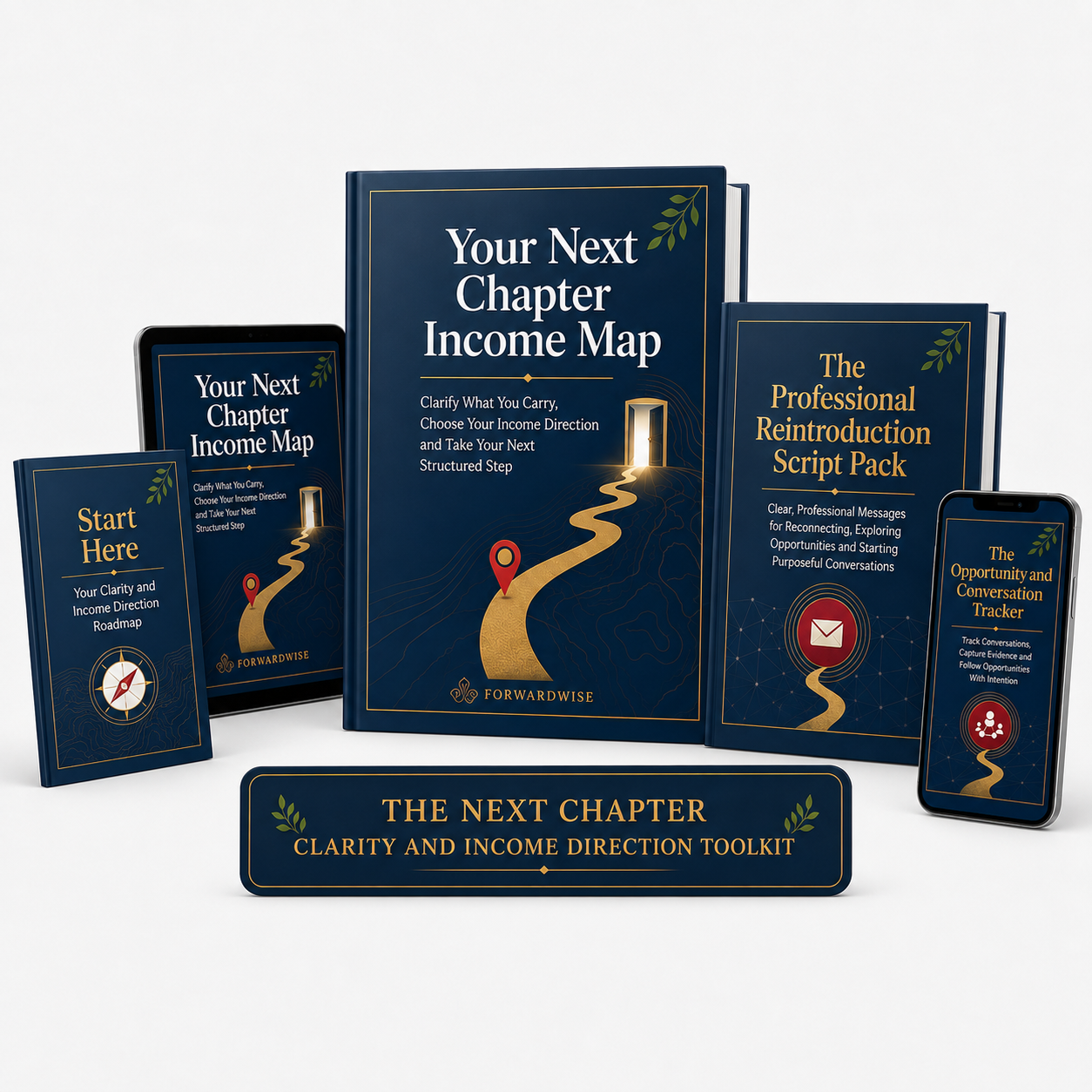
That is why this process has been organized into four practical resources that work together: one core guide to help you build clarity and choose direction, supported by tools to help you navigate the process, reintroduce yourself professionally and track the conversations and opportunities that follow.
Introducing...
The Next Chapter Clarity and Income Direction Toolkit
Clarify What You Carry, Choose Your Income Direction and Take Your Next Structured Step
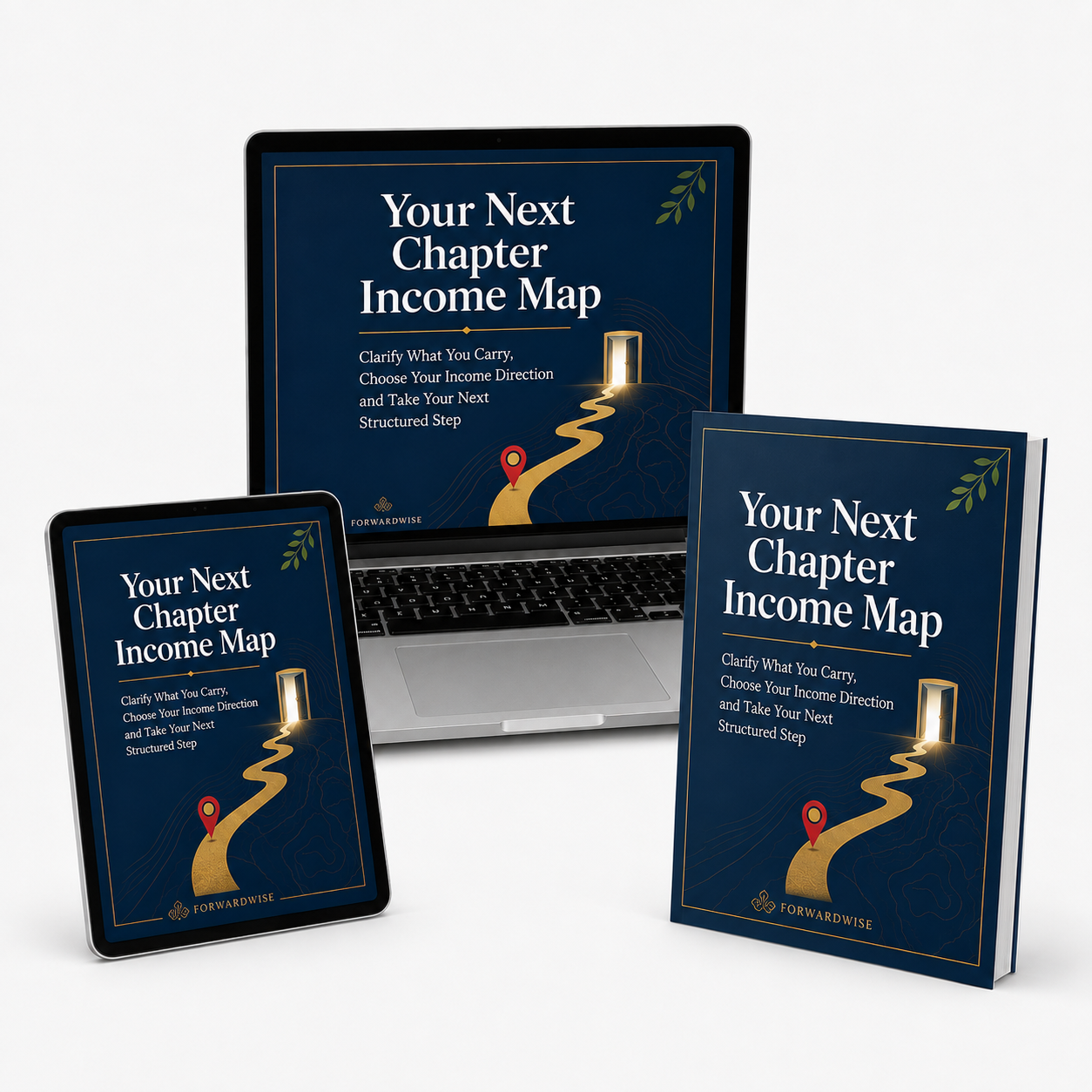
Inside The Toolkit, You’ll Receive:
1. Start Here: Your Clarity and Income Direction Roadmap
A short orientation guide that shows you how the four resources work together and gives you a practical 7–14 day pathway for working through the toolkit without becoming overwhelmed.
2. Your Next Chapter Income Map
The core guide that takes you through six stages — Stabilize, Separate, Recover, Reassess, Select and Direct — helping you understand your transition, uncover the value in your experience, compare realistic income pathways and build a focused thirty-day direction.
3. The Professional Reintroduction Script Pack
Clear, professional messages you can adapt when reconnecting with former colleagues, sector contacts and other people who may help you learn, explore opportunities, request introductions or begin purposeful conversations.
4. The Opportunity and Conversation Tracker
A practical tool for recording the people you contact, the conversations you hold, what you learn, opportunities that emerge and the follow-up actions you need to take.
And the best part? You do not need to have your entire next chapter figured out before you begin. The toolkit helps you slow down enough to understand what you carry, choose a direction worth exploring and move into real-world conversations and action with greater clarity.
This is a new resource. Verified reader experiences will be added only after real customers have used the guide and given permission for their feedback to be published.
A Practical Toolkit at an Introductory Launch Price
The Next Chapter Clarity and Income Direction Toolkit brings together four practical resources designed to help you move from uncertainty toward clearer direction and structured action.
For the introductory launch, the toolkit is available at:
Introductory Kenya price:
This introductory launch price may be reviewed after the initial market-validation period.
You will be taken to the secure Selar checkout page to complete payment using the available payment options.
Two Practical Tools to Help You Put Your Clarity Into Action
Alongside the core Income Map and the Start Here Roadmap, these two practical tools help you move from reflection into purposeful conversations, evidence gathering and follow-through.
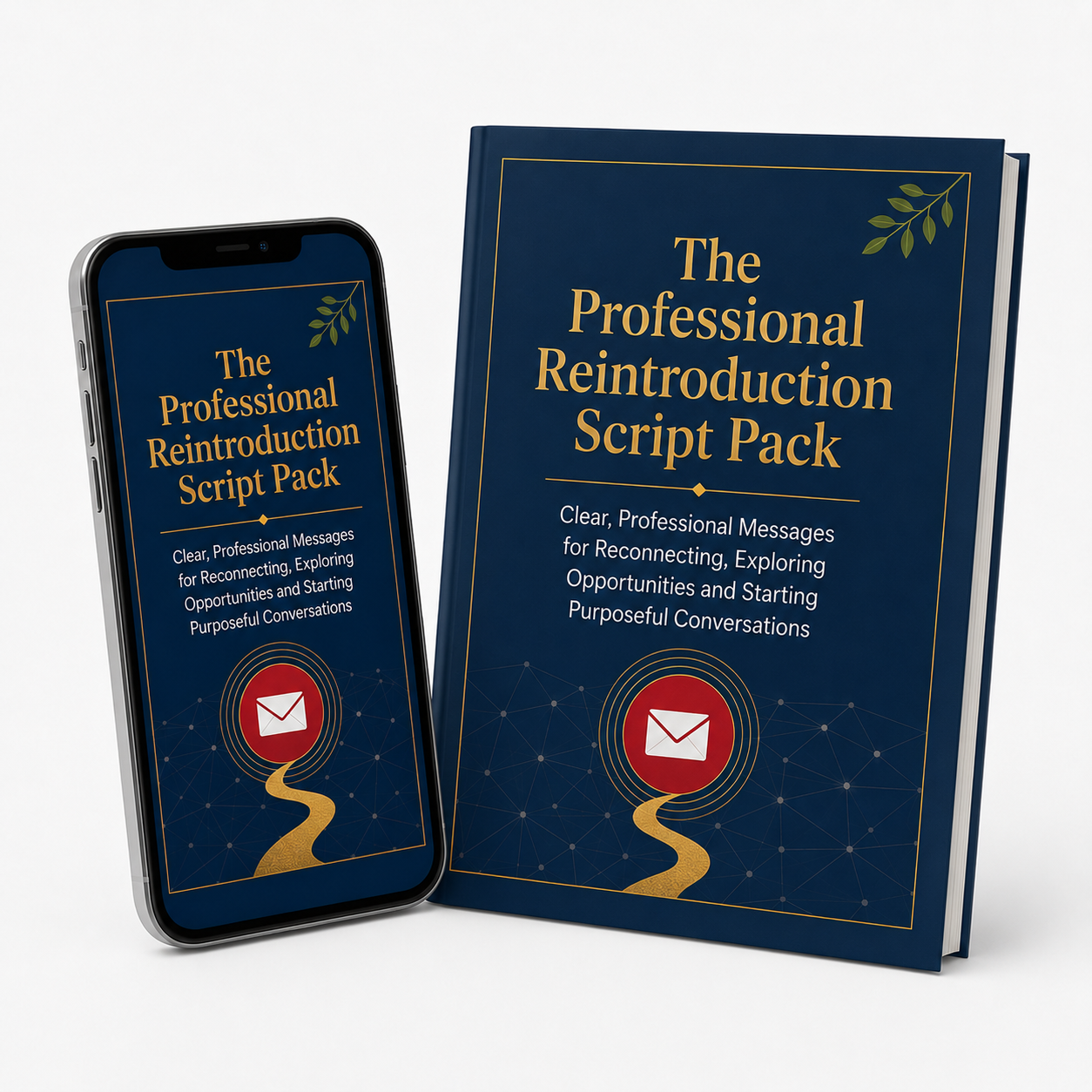
The Professional Reintroduction Script Pack
Clear, professional messages you can adapt when reconnecting with former colleagues, sector contacts and other people who may help you explore opportunities, request introductions or begin purposeful conversations.
The scripts help you communicate what you are exploring without sounding vague, desperate or as though you are asking people to find work for you.
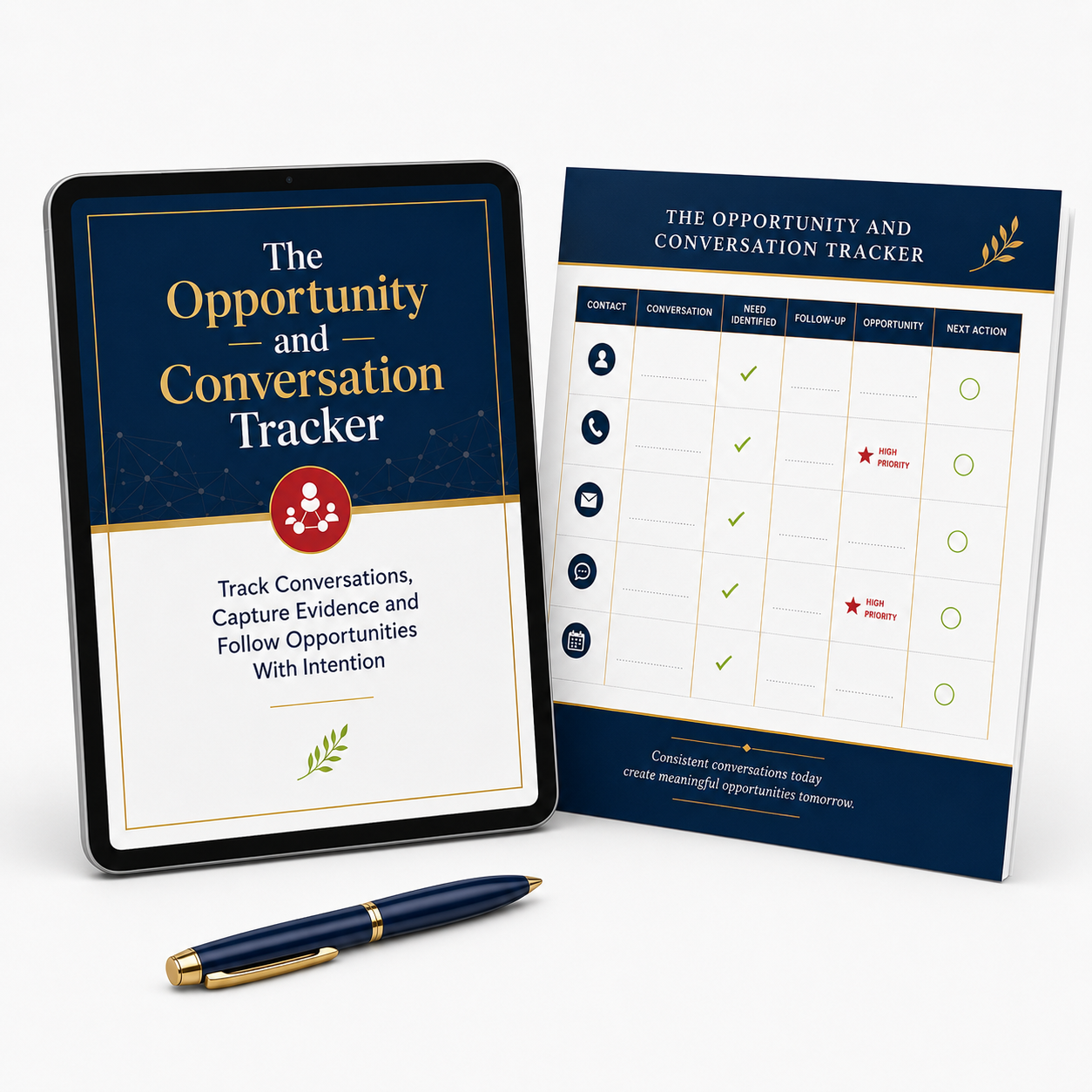
The Opportunity and Conversation Tracker
A practical tool for recording the people you contact, the conversations you hold, what you learn, opportunities that emerge and the follow-up actions you need to take.
It helps you turn conversations into useful evidence and stay intentional about what to pursue, follow up or set aside.
Still Feeling Unsure? I Totally Understand.
Which is why this toolkit comes with a simple, risk-aware promise.
7-Day Clarity Guarantee
Work through the Start Here Roadmap and the core clarity exercises in Your Next Chapter Income Map within seven days of purchase.
If the process does not help you gain greater clarity about the value you carry, the income directions worth exploring and the next structured step you can take, contact us within seven days of purchase and briefly tell us which parts of the toolkit you completed and where you still feel unclear.
We will refund your purchase price.This guarantee applies to the clarity and usefulness of the toolkit. It does not guarantee employment, clients, contracts or a specific financial result. Get the Next Chapter Clarity and Income Direction ToolkitYou Now Have Two Choices
Option 1
Take a structured next step. Get The Next Chapter Clarity and Income Direction Toolkit and use the four resources to understand what has changed, clarify the value you carry, compare realistic income directions and begin testing your next steps through purposeful conversations and action.
Option 2
Continue exploring on your own. You may decide that now is not the right time to use a structured process and continue working through your options in your own way.
The important question is whether your current approach is helping you become clearer about what you carry, where it may be useful and what you will do next.
The toolkit is currently available at the introductory launch price.
Your formal role may have ended. The experience, credibility and value you built did not end with it.